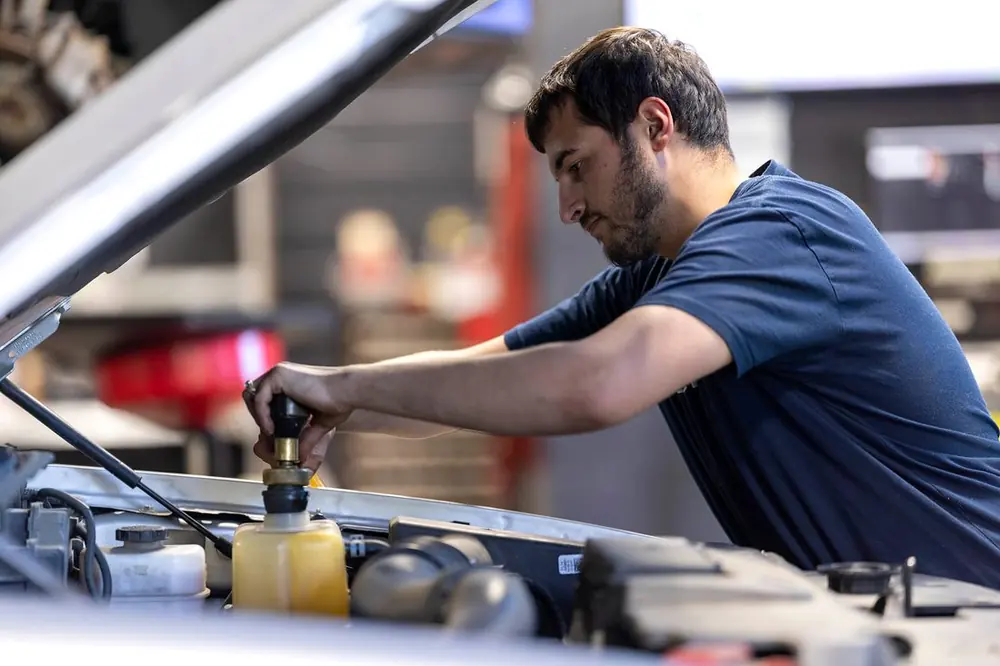
Short answer: Most car questions come down to a noise, a warning light or overdue maintenance. Tell us what you notice and when it happens, and we’ll test the car and show you what we find before anything gets fixed, with our diagnostics service.
Where these questions came from
In 2018 our technicians joined Boys Under The Hood, a local radio show on Tuesday mornings where listeners called and wrote in with car questions. The same questions still come up at our shops every day, so we’ve gathered the answers in one place.
How to describe a car problem
- What: a noise, a smell, a light, a shake or a pull?
- When: cold start, braking, turning, speeding up or over bumps?
- Where: front, rear, left or right?
- How long: did it start suddenly or build up, and is it getting worse?
- Recent work: any repairs or new tires lately?
The more you tell us, the faster we can test the right system. If a noise is hard to describe, we’ll take a ride with you so we’re chasing the same problem you are.
Why is my check engine light on?
It can be as small as a loose gas cap or as big as a misfire. A code points to an area, not a part, so it takes testing to find the cause. A flashing light means stop driving soon and get help. Read more about check engine light diagnosis.
What’s that noise when I brake?
Squealing often means the pads are getting low, and some pads have a wear indicator built in to make that sound. Grinding usually means metal on metal, which can ruin rotors fast. Have it checked soon at a brake repair visit.
Why does my car pull or wear tires unevenly?
Pulling, an off center steering wheel and tires worn on the edges usually point to alignment. Worn suspension parts can cause a pull too, so we check both. See wheel alignment.
What’s that clunk over bumps?
A clunk or knock over bumps, bouncing, or the nose diving when you brake often points to worn shocks or struts. Noises can also come from mounts, bushings and ball joints, so we find the real cause before replacing anything. See suspension and steering.
Why does my car shake at highway speed?
It can be tires, a torn CV boot and axle, or a worn driveline part. We’ve traced highway vibration to a torn CV boot on a Subaru and to a carrier bearing on a Porsche Cayenne. A road test tells us where to look.
How often should I change my oil?
It depends on your car and the oil it uses, so check your owner’s manual or ask us. Many New England drivers fall under the severe service schedule, which means sooner. See what skipping oil changes does to your engine.
Why is my car hard to start in the cold?
Cold weather saps battery strength just when the engine needs more power. A weak alternator can look like a bad battery too, so we test both. See battery and no start.
Why is there no heat?
Low coolant, a leak, a stuck thermostat or a heater core problem are common causes. See AC and heating repair.
Questions to ask a shop before you say yes
- What’s wrong with my car, and how did you find it?
- What happens if I wait?
- Can you show me the old part, or send photos?
- What’s the total cost and how long will it take?
- What warranty comes with the repair?
We send photos and videos of what we find, and you approve everything before work starts. Nearly every repair carries 3 years or 36,000 miles, brakes carry 12 months or 12,000 miles, and our labor is guaranteed for life.
Questions we hear
Can you tell me what’s wrong over the phone?
Often we can narrow it down, but a real answer needs a road test and an inspection.
Should I bring my own parts?
We don’t install customer supplied parts. We can’t confirm the part is right or good quality, and it makes it hard to stand behind the work.
Is it worth fixing an older car?
Often it is. If a repair costs more than the car is worth, we’ll tell you.
Is it rude to ask for a second opinion?
Not at all. Informed customers make better choices.
Have a question about your car? Call West Springfield at (413) 363-0306 or South Windsor at (860) 896-5911, or book a visit at our West Springfield or South Windsor shop.